How to Show Up in ChatGPT and Google AI Overviews When Customers Search Your Industry
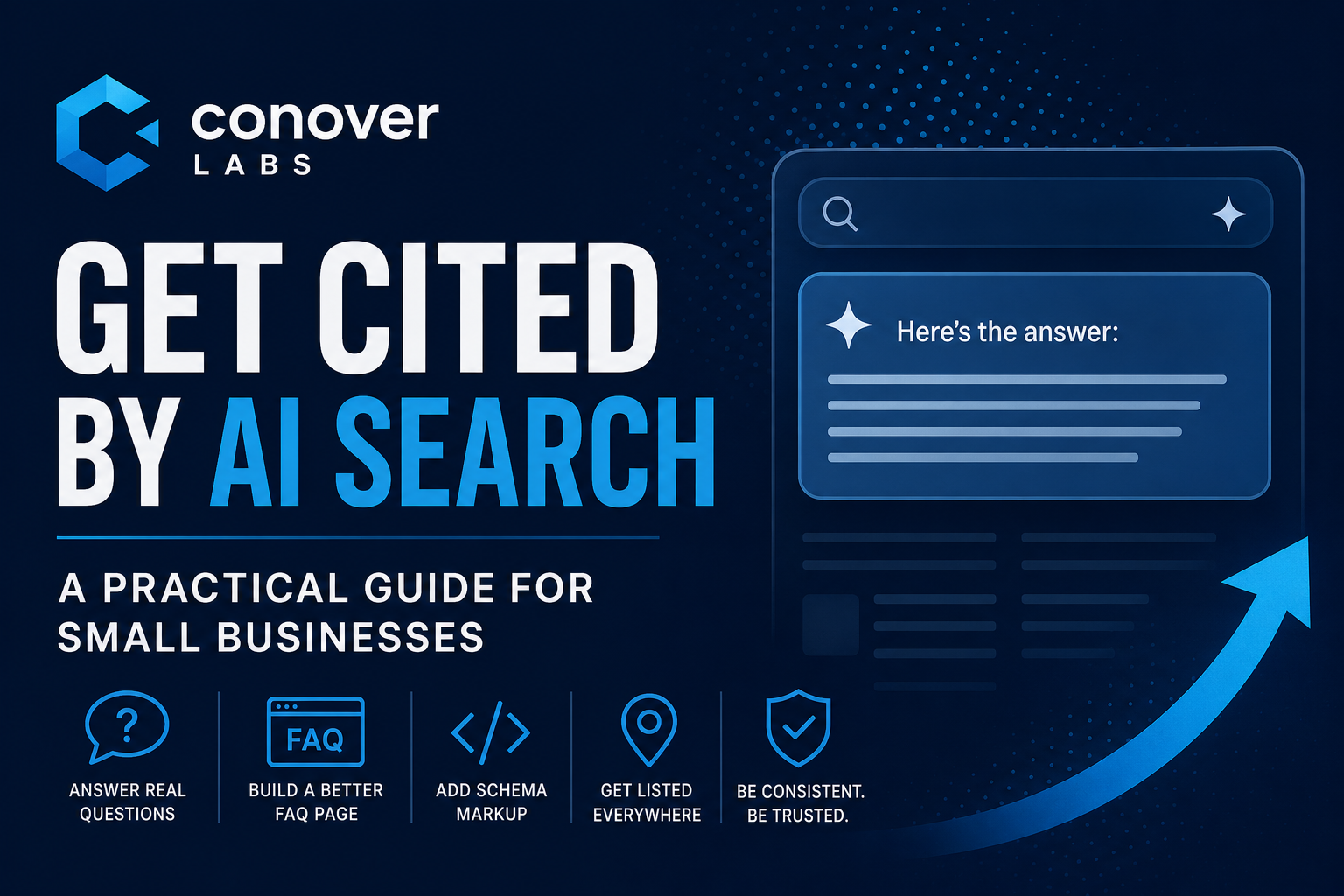
Somewhere between “AI is changing search” and actually getting cited in an AI answer, there’s a list of specific things to do. That list is what this post is.
The theory is widely covered. You’ve heard it. What most posts skip is the specific work: the page structure, the markup, the directories, the exact kind of writing that gets lifted into an answer. Let’s do that part.
Write so the AI can actually pull your answer out
This is the mechanical core of all of it. LLMs lift sentences and short paragraphs, not pages. The model reads your page and finds the part that most directly answers the question someone is asking. So write that way.
Lead with the answer. Not the context, not the caveat, not the background. The answer first. Then the explanation. This is the inverted pyramid journalists have used for decades, and it works for the same reason: get to the point, then give the reader (or the AI) the detail if they want it.
Each paragraph should make a single point and be readable on its own. “As we discussed above” or “which we’ll cover next” breaks an excerpt the moment it gets pulled out of context. Write self-contained paragraphs.
Define your terms once, in a short standalone sentence. If you’re a plumber, something like “A tankless water heater heats water on demand instead of storing it in a tank, which means no running out of hot water and no paying to keep a tank warm all day.” That sentence is citation material. A paragraph that dances around the definition without stating it is not.
Use real specifics. A price range. A timeline. A named product. “We typically finish a bathroom remodel in 8-12 days” is more useful to an AI and to a customer than “our turnaround is industry-leading.” LLMs cite specifics. They have no reason to cite a vague claim.
One more thing: don’t answer “contact us to learn more.” If a customer has a real question and the answer on your page is “call us,” that’s a dead end for the AI and for the person. Answer the question. Then put the contact information after.
Build a real FAQ page, not a keyword list
FAQ pages work well for generative engines because the format matches the query format. A question in a customer’s head becomes a prompt in ChatGPT, which ideally finds a page that happens to have written out exactly that question and a clean answer to it.
The problem is most small business FAQ pages ask the wrong questions. “What areas do you serve?” is a keyword-era question. “Do you take customers in [suburb], or are you mostly downtown?” is how a real person asks. Write the questions the way a person would type them to a friend or an AI. Specific, natural, a little long.
Keep the answers short. Two to five sentences, self-contained. If the answer genuinely needs ten paragraphs, it’s an article, not a FAQ answer.
Don’t bury answers in a JavaScript accordion that hides them until clicked. Most crawlers handle this now, but some don’t, and there’s no upside to the risk. Render the text as visible HTML.
Add FAQ schema to the page. More on schema below, but FAQ schema specifically tells search systems that this content is a structured question-and-answer pair. It’s what drives the expandable Q&A sections that sometimes appear in results, and it helps AI Overviews pull clean pairs.
The questions worth covering for most small businesses: how much does it cost, how long does it take, how does the process work, what happens if something goes wrong, do you offer this specific thing, why would I hire you instead of the obvious alternative. Those are the actual objections. Answer them honestly.
Add structured data to your site
Schema markup is machine-readable metadata. It doesn’t change how your site looks. It tells search engines and AI systems, in a standard format, what your business is and what it does.
LocalBusiness schema is where most small businesses should start. Within that, there are specific subtypes: PlumbingService, AutoRepair, LegalService, MedicalBusiness, and so on. Use the most specific type that applies. Fill in name, address, phone number, url, openingHours, areaServed, and priceRange at minimum.
FAQ schema goes on pages that have real FAQ content. It wraps each question-answer pair so they’re directly extractable.
How to add it: JSON-LD is the standard format, added to the head of the relevant pages. You don’t need to hand-code it. Schema.dev has free generators. Google’s Structured Data Markup Helper walks you through it in a browser. Once it’s added, Google’s Rich Results Test tells you if it’s valid.
Realistic expectation: schema doesn’t guarantee a citation. It removes friction for the machines trying to read your page. Think of it as making your content legible to a search system, not as a ranking trick. The content still has to earn it.
Get mentioned off your own site
LLMs were trained on the web. The sites they treat as authoritative are the ones that were already well-represented in their training data: Wikipedia, major directories, review platforms, local news, industry databases. That means the directory listings and review profiles many small businesses have been ignoring for years matter for a new reason now.
Google Business Profile is the single highest-return thing a local service business can do for AI visibility and local search combined. Fill it out completely. Real photos, not stock. Current hours, including holidays. A description that uses your actual services in plain language. Respond to reviews. A complete, active GBP listing is what shows up in maps, AI Overviews for local queries, and voice search results.
Beyond GBP: Yelp is still heavily crawled and cited. The industry-specific directories vary by trade. Houzz for home services. Avvo or FindLaw for legal. Healthgrades for healthcare. Angi and Thumbtack for general services. Your local Chamber of Commerce listing. Whatever the relevant professional association or certifying body is in your field. You don’t need to be everywhere. You need to be on the platforms already treated as authoritative in your category.
The thing to get right on all of them: consistent name, address, and phone number. Exactly consistent. “123 Main St” and “123 Main Street” are different strings. Inconsistent listings create ambiguity that hurts both local SEO and AI citation accuracy. Pick a format and use it everywhere.
What to do this week, in order
Five things, prioritized rather than dumped:
-
Google Business Profile. If you haven’t claimed it, claim it. If you have, spend an hour making sure it’s fully and accurately filled out. This is the highest-leverage single action for a local business.
-
Read your most important page. Your homepage, or the main service page. Does it lead with answers, or bury them? Is there a sentence that clearly defines what you do and for whom? If you pulled one paragraph out and pasted it as a standalone quote, would it make sense and be clearly about your business?
-
Write or rewrite your FAQ page. If you don’t have one, write 8-12 real questions and honest answers. If you have one, rewrite the questions to sound like how an actual person asks, not how a keyword would appear.
-
Add schema markup. LocalBusiness schema on your homepage, FAQ schema on your FAQ page. Use a generator, run it through the Rich Results Test to confirm it’s valid.
-
Check your directory consistency. Search your business name and look at what comes up. Yelp, Yellow Pages, Bing Places, any industry directories. Check that the name, address, and phone match. Fix what doesn’t.
That’s a full week of work for most businesses. It covers the foundations. The content strategy and ongoing publishing are the longer game, and they matter, but these five things are largely one-time work that pays back immediately.
The honest framing
There’s no trick that gets you cited in ChatGPT by Friday. The businesses that consistently show up in AI answers are the ones whose sites are well-structured, whose content directly answers real questions, and who have a real presence on the web beyond their own homepage.
That’s also a description of a good website that serves customers well. The alignment isn’t accidental. AI systems reward the things humans have always wanted from a business online: clarity, specifics, and evidence that a real person with actual experience is behind the page.
If your site already does that, you’re closer than you think. If it doesn’t, fixing it is worth doing regardless of how AI search shakes out.
Have a project in mind? We'd love to hear about it.
Start a conversationRelated posts
GEO vs SEO: What Generative Engine Optimization Is and Why It Matters Now
What GEO is, how it differs from SEO, and why small businesses need their websites to be found by AI answer engines too, not just Google.
SEO Is Dying. Here's What Replaces It.
Google AI Overviews and ChatGPT changed the research phase of customer decisions. Here's what GEO and topical authority mean for your content strategy.
Private Equity Bought Your Competitor and Gave Them a Tech Stack
PE-backed roll-ups are winning home services on response speed and booking systems. Most of that stack is rentable. Here's how to keep up.